Saturday, March 19, 2016

Spring Sale on Our Pasture Raised Black Angus Beef!


Our steers were gently raised on Our Tiny Farm in Etowah, NC. They lived on our pastures for two years eating the fresh grass growing there. In the winter we also fed them locally grown hay, carefully selected to not contain persistent herbicides. The meat was dry-aged for several weeks, butchered, vacuumed packed, and frozen at a USDA inspected facility in Forest City, NC. The beef is boxed and being held in deep freezers at a local commercial packing house.

These steers were harvested late last fall, but because of family health issues, we had to halt our beef sales this past winter, so now we are offering the following spring specials:
Quarters (average weight of 89 lbs) for $8.50 per pound
20 lbs of ground beef (1 lb packages) for $7.25 per pound
Liver for $3 per pound
(plus 2% sales tax)
New York Strip Steak
We sell our meat as finished, packaged weight; just like you would buy meat in a butcher shop or supermarket. (Many farmers sell their beef as "hanging weight" which includes the bone and excess fat. The way we sell it, you know exactly how much meat you are getting). An average quarter contains 6 ribeye steaks, 8 NY strip steaks, 6 filets, 1 round steak, 1 sirloin steak, 2 sirloin tip roasts, 1 London broil, 2 chuck roasts, 2 arm roasts, 6 stew beef (1 lb pkgs), and 50 ground beef (1 lb pkgs)  (this will, of course, vary slightly from quarter to quarter). We don't sell a front or back quarter but make an even assortment for each. We do not include soup bones or ribs in our quarters, i.e., you get more meat and less bone.

If 89 pounds of beef sounds like a lot, you can always split it with another family, but it also holds in a home freezer for a very long time. We are still eating some of our beef from November 2013 that we store in a chest freezer and it tastes as fresh and juicy as it did over two years ago. The vacuum packaging is what does it. If you plan to store the meat for a long time, to maintain the best quality we recommend you store it in a chest or upright freezer and not in the freezer compartment of your refrigerator. We also like the vacuum packaging because you can quickly thaw ground beef, stew beef, and steaks by putting them in a sink full of water for 20 to 30 minutes. We do not recommend thawing pasture raised or grass-fed beef in the microwave.

A quarter of beef takes up about 5 to 6 cubic feet of freezer space.  Our small chest freezer will hold a quarter with room to spare. The meat will be frozen solid and packed in two sturdy boxes. Please come prepared to transport frozen meat. If you don't have far to travel, you can just wrap blankets around the boxes. But if you have to travel for an hour or so, bring some large coolers or something to keep your beef frozen solid.
Why don't we call our beef "grass-fed"?  The term "grass-fed" is a legal term for beef that has ONLY been fed fresh grass and hay. Fresh grass and locally grown hay make up more than 99% of our steers' diet, but we do give them a cupful of sweet feed (grain and molasses) once in awhile to keep them "trained to a bucket". That means if they ever get out of the fenced pasture, they will come running to us when they hear us shake the buckets. So technically, we can't call our steers "grass-fed". We do not feed our steers hormones or antibiotics. We do not fertilize or spray herbicides on our pastures and we use fly predators (tiny wasps) as the basis for our fly control program. We are NC licensed meat handlers and are certified Appalachian Grown by ASAP.

If you are interested in buying or want to learn more, use the contact form on the right sidebar (if you are on a smartphone or tablet and don't see a sidebar, scroll to the bottom of this page and click on "View Web Version" and it will show up). You can make an appointment to pick up the beef at our farm in Etowah or we can arrange to meet you near the Asheville airport. We accept cash and credit cards or you can pay through Paypal.

Saturday, November 28, 2015

Wild-simulated ginseng: sowing your seeds and applying gypsum

stratified ginseng seed
Picking up from my last post, let's assume you have your wild-simulated ginseng site all prepared. You are now ready to plant the high-quality, stratified seed that you have purchased or stratified yourself. But how much should you sow? Let's refer to what Scott Persons says in our book Growing and Marketing Ginseng, Goldenseal and Other Woodland Medicinals:

"From my own experience and that of other growers, I am convinced that at least one, but no more than two, mature plants per square foot is best. Anything denser courts disaster by facilitating the spread of disease. Anything thinner does not optimize the financial potential of the operation, though I'd certainly recommend erring on the side of caution."

To get this density, you need to plant four to eight seeds per square foot. Why so many? Because even with the best of seeds, you can expect to lose a large percentage of your seeds to birds, insects, rodents, poor soil contact, drying out, being washed away, etc. During the first few years of growth you will lose even more to the same causes and to winter kill, being crushed underfoot, being covered too deeply with leaves and branches, and to other causes I can't even think of right now. By the time the plants are three to four years old, you should have just about the right density.

Scott estimates that there are 6,400 to 8,000 seeds per pound, or between 400 and 500 in an ounce. So, according to Scott's calculations "if you sow one ounce of seed on 100 square feet of land or, as I prefer, two ounces (between 800 and 1,000 seeds) on 200 square feet, you can achieve an average planting density of between four and five seeds per square feet, or about 25 pounds of seed to the acre."

Scott is a very practical and well-organized person. He plans his seeding trips out carefully so he can be quick and efficient when he reaches his planting site.
wild-simulated ginseng seed sowing
"Just before going into the woods to plant, weigh out your seeds into multiple plastic bags and place them in a small cooler, or at least a covered bucket."  If you prepared 200 square foot sections, weigh out 2 ounces per bag. Using one bag per section, you will have a final sowing rate of one ounce of seed per 100 square feet. Scatter the seeds to the left and right of you as you walk slowly over your section. After the first few times, you will get a good feel for how to get the seed spread evenly over the section.
gypsum on ginseng seed bed area
In another post, we will talk about gypsum (or you can read about it for yourself on pages 64-65 in the book), but for now let's assume that you have decided to apply 10 lbs of gypsum on your 200 square foot section of planting area. Scatter it evenly over the planted area. I just put the weighed out gypsum in a small bucket and scatter it by hand. Some people use a small hand cranked fertilizer spreader.
replacing leaves on wild-simulated ginseng planted area

Then, and this is the slick part of this method, "stand on the strip that you've just sown, reach straight uphill with your rake, and, again using the five-foot mark on the rake handle as a guide, rake down the next five feet of leaf litter directly onto the stip you've just seeded." In this way you are mulching (covering up) the area you just planted while at the same time, uncovering the next area to be planted. Sow seed and gypsum on that new section, and then pull down another five foot swath of leaves to mulch that area and expose a new planting area.  "Note that you have not moved any leaves more than once, and with the exceptions of the bottom and top sections, every rake stroke has accomplished two tasks." On steep slopes, you might want to lay limbs and small branches on top of the leaves to hold the mulch in place. 

If you are serious about growing woodland medicinal herbs, whether for a business or your own personal enjoyment, this is the book to have. Written by two well-know authorities, the book is chock full of information and hundreds of pictures on how to grow ginseng, goldenseal, ramps, black cohosh, and many other native herbs.

How to Get a Copy of the Book: We suggest you order the book through the publisher, New Society Publishers, or your favorite local book store; that way the authors can receive their full royalties. It is available in bookstores where native plant gardening is popular. You can order the book through all the big on-line discount book sellers. Many sellers offer the book on Ebay. The book is also available as an ebook through Amazon, Barnes and Noble, New Society Publishers, and elsewhere.

The book is a high-quality soft cover book with 508 pages. It has a center color photo section and black and white photos throughout. Here is detailed information about the book and a link to the table of contents.

Sunday, November 22, 2015

Growing Wild-Simulated Ginseng: Preparing the Planting Site

 
I am so pleased at how many people are buying ginseng seed this year to start their own wild-simulated ginseng patches. That is wonderful news! They are creating their own income producing areas and helping to conserve the wild populations.

But so many of these people don't know how to grow wild-simulated ginseng. Today's short lesson will be on preparing the site. I am going to assume that you have already selected the perfect site for your ginseng. You have your high-quality, stratified seed on hand, and you are ready to plant. Reading from Scott Person's section on Wild-Simulated Planting in our book Growing and Marketing Ginseng, Goldenseal and Other Woodland Medicinals:

"Before you plant, you need to rake aside the leaf litter, and it is difficult to rake efficiently where there are dead limbs and rocks lying around or lots of small saplings, vines, and shrubs growing. Even if you cast seeds on top of the leaf litter and then till them into the top inch or two of ground-an approach that some growers swear by-you'll need to clean and clear to make space for the tiller to operate."

Scott goes on to describe exactly how to do this, what to remove and what is better left behind, and how to prevent erosion on slopes.
Scott also describes how to mark off your planting area so you have some control over planting density:

"I like to plant 40' wide sections (or only 20' wide, if 40' isn't practical), beginning at the lowest part of the planting site and moving directly up the face of the slope to the top of the site. Then I go back to the bottom and plant an adjacent and parallel section and so on, until the entire area is sown."

He goes on to describe exactly how to do this and the pros and cons of using small wooden stakes, surveyor's flags or heavy-duty surveyor's stakes.
The next step is raking off the leaf litter:

"Take a large rugged leaf rake, measure five feet from the tip of the tines to a spot on the handle, and make a highly visible permanent mark there. Then, start at the bottom of one of your measured sections, face directly uphill, and, using the mark on your rake handle as a guide, rake the first five feet of leaf litter down and off the soil across the entire width of the section."

Scott goes on to describe how to do this up the entire hill and signs of some pesky critters to look for.
This is what your planting area should look like prior to sowing your seed and spreading your gypsum. I'll cover that in a future post.

If you are serious about growing woodland medicinal herbs, whether for a business or your own personal enjoyment, this is the book to have. Written by two well-know authorities, the book is chock full of information and hundreds of pictures on how to grow ginseng, goldenseal, ramps, black cohosh, and many other native herbs.

How to Get a Copy of the Book: We suggest you order the book through the publisher, New Society Publishers, or your favorite local book store; that way the authors can receive their full royalties. It is available in bookstores where native plant gardening is popular. You can order the book through all the big on-line discount book sellers. Many sellers offer the book on Ebay. The book is also available as an ebook through Amazon, Barnes and Noble, New Society Publishers, and elsewhere.

The book is a high-quality soft cover book with 508 pages. It has a center color photo section and black and white photos throughout. Here is detailed information about the book and a link to the table of contents.

Thursday, November 5, 2015

Pasture Raised Beef Available Soon and Reflecting Back on the Growing Season

 
We will have our pastured raised Black Angus beef available very soon. Right now the meat is dry aging. Then it will be butchered, vacuum-packed, frozen, and packed into quarters. And then we will make it available for sale to you direct from the farm. We won't have prices or know the size of the quarters until we have the meat on hand, but you can reserve a quarter now. Just use the contact form on the right side bar (if you are using a smartphone or tablet and don't see a side-bar, scroll to the bottom of the page and click on "View web version"). We will post all those details as soon as they are available.
For two years these boys have been living the good life roaming free in our pastures and down into the bog. They got personal attention from us every day, i.e., we spoiled them rotten! They loved to run up to the gate to get their ears scratched and lick our hands. When we took the tractor into the pasture to move their portable lean-to or put a round bale of locally-grown hay into the hay ring, they would run around like giant puppies, challenging the tractor as if it were a new animal in their pasture. We miss seeing them every day, but thanked them for sharing their lives with us and for providing high-quality meat to feed our family and yours.
It is a beautiful fall in western North Carolina. I don't ever remember the colors being this brilliant. As we enjoy the colors and cooling temperatures, we reflect on the growing season and say thank you to our customers for making this a profitable year for us.
The garlic crop was of excellent quality and we sold all of it on-line, much of it to repeat customers, so we must be doing something right.

It has taken us several years to rebuild our hives after losing almost all of them to colony collapse, but this fall we got enough of a crop to again offer honey for sale. The demand for local honey is strong and we sold out at the Hendersonville Apple Festival. So we won't have honey at the Holiday Market at the Mills River Farmers' Market this year.
So all in all, it was a good year. Now it is time to sit back, enjoy the sunshine and my donkeys and decide what we want to do next year. Should we raise the same crops? Should we try something new? Should we raise more Black Angus steers or try another breed?  Should we board donkeys instead of horses (that is my idea which isn't going very far with the rest of my family). If you have any ideas you want to share, please let us know. Thank you for supporting Our Tiny Farm.

Thursday, October 22, 2015

Elephant Garlic Bulbs On Sale-Mountain Grown, Reasonably Sized

Sold Out-thanks for supporting Our Tiny Farm
PRICE DROPPED TO $45.00 PER 4+ LB. BOX (SAVINGS OF $13.00)
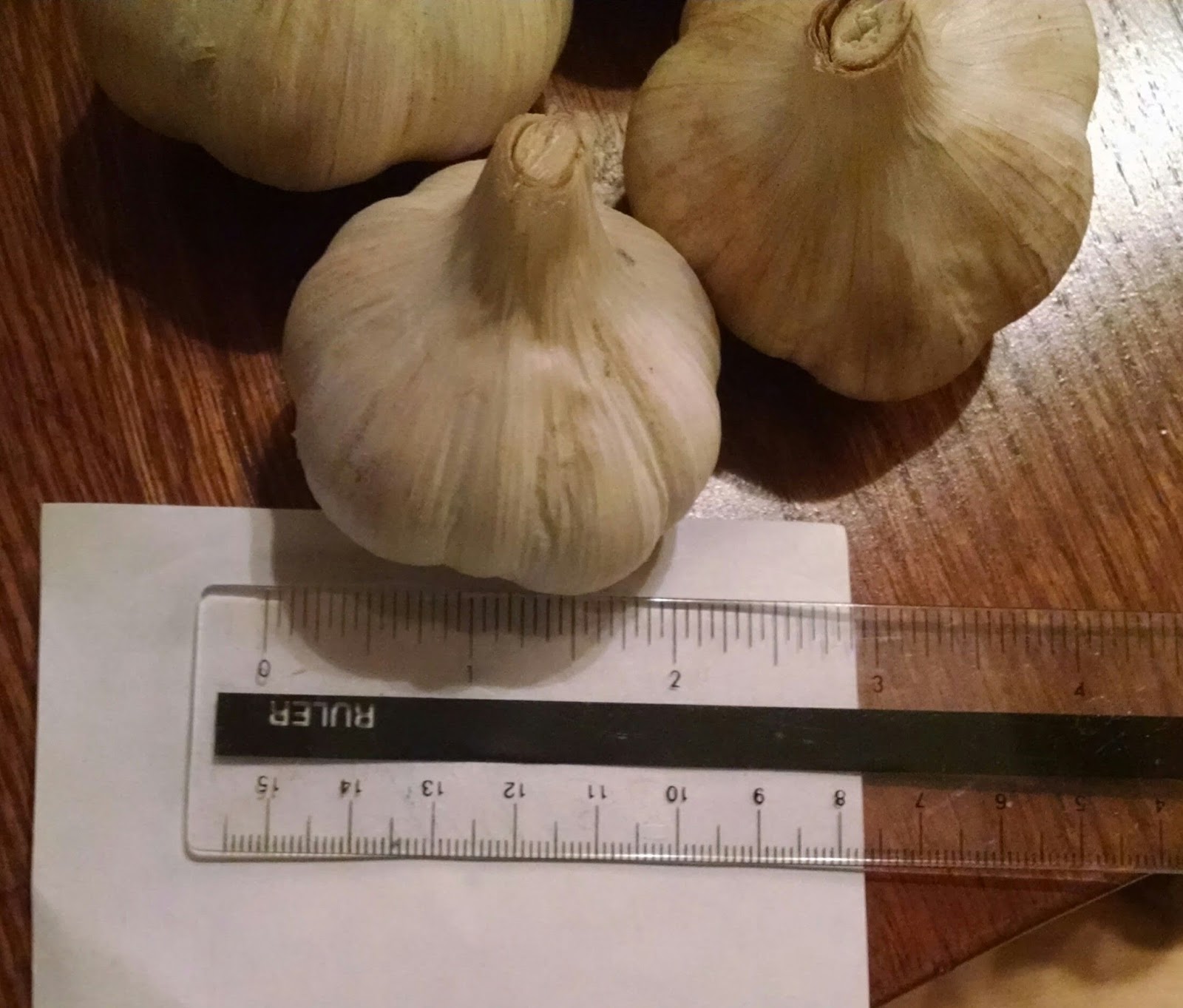
Every year when we grow Elephant Garlic we grade out the bulbs that are about the same size as our German White bulbs and package them separately. We refer to these as "reasonably sized" Elephant Garlic. This is excellent Elephant Garlic with well-formed, firm bulbs that are about 2 inches in diameter. We sell it as eating garlic but we are also using it as planting garlic. We currently have four boxes of "reasonably sized" Elephant Garlic left. Each box contains at least 4 pounds and 28 bulbs. We will ship this directly to you via Priority Mail. Just click on the appropriate "Add to Cart" button on the right (If you are on your smartphone and don't see any Paypal buttons to your right, scroll to the bottom of the page and click on "View Web Version").

These garlic were grown on our small family farm in the Blue Ridge mountains of western North Carolina. We grow all our produce using only practices and products in accordance with the USDA National Organic Program. No pesticides, fungicides, or herbicides were used to grow these garlic. We carefully rotate our crops every year, fertilize with well-aged manure from our animals and homemade compost tea, and weed with hands and hoes. We hand-pull the garlic in late June and dry it on racks in our open air sheds. It is then trimmed, cleaned, and packed for shipping. It was an excellent garlic year for us and this is all we have left of our 2015 'Elephant Garlic' crop.

Tuesday, October 20, 2015

Do you like the taste of Elephant Garlic but not the huge bulbs?

SOLD OUT
About five years ago we had a group of customers tell us they like the taste of Elephant Garlic but they don't like the huge bulbs. So every year when we grow Elephant Garlic we grade out the bulbs that are about the same size as our German White bulbs and package them separately. We refer to these as "reasonably sized" Elephant Garlic. This is excellent Elephant Garlic with well-formed, firm bulbs that are about 2 inches in diameter. We sell it as eating garlic but we are also using it as planting garlic. We currently have four boxes of "reasonably sized" Elephant Garlic left. Each box contains at least 4 pounds and 28 bulbs. We will ship this directly to you via Priority Mail. Just click on the appropriate "Add to Cart" button on the right (If you are on your smartphone and don't see any Paypal buttons to your right, scroll to the bottom of the page and click on "View Web Version").
These garlic were grown on our small family farm in the Blue Ridge mountains of western North Carolina. We grow all our produce using only practices and products in accordance with the USDA National Organic Program. No pesticides, fungicides, or herbicides were used to grow these garlic. We carefully rotate our crops every year, fertilize with well-aged manure from our animals and homemade compost tea, and weed with hands and hoes. We hand-pull the garlic in late June and dry it on racks in our open air sheds. It is then trimmed, cleaned, and packed for shipping. It was an excellent garlic year for us and this is all we have left of our 2015 'Elephant Garlic' crop.

Friday, October 16, 2015

Garlic and Ginseng Seed, Rootlets, and Book for Sale at Our Tiny Farm!

This is what we currently have for sale at Our Tiny Farm:
                                                                        SOLD OUT!
Right now we are selling 4 lb boxes of mountain grown, whole bulb garlic. We are selling it as eating garlic but we are using it as planting garlic, too. We have one box of German White garlic and 4 boxes of "reasonably sized" Elephant garlic left. All is firm, healthy, and oh so tasty. Order by clicking on the appropriate Add to Cart button on the right (If you are using your smartphone and don't see those buttons, scroll to the bottom of this page and click on "View Web Version"). More details about the garlic in the previous post (Sept. 29). Later this fall we will be selling packaged cloves, appropriate for gift giving or your own kitchen use.

  SALE OVER AS OF 11/3/2015.
We still have our special with three-year-old ginseng rootlets plus book offer going on. This is for 10 three year old ginseng rootlets from High Valley Ginseng in north Georiga with a lead author (me) signed copy of our book Growing and Marketing Ginseng, Goldenseal and Other Woodland Medicinals. See the post from Sept. 15 for details.
 SALE OVER AS OF 11/21/2015
We also still have our special for ginseng seed plus book offer going on. This is for 2 oz of high quality, water tested, stratified seed from Green Gold Enterprises with a copy of our book Growing and Marketing Ginseng, Goldenseal and Other Woodland Medicinals signed by Scott Persons. See the post from Sept 15 for details. 
  SALE OVER AS OF 11/21/2015 BUT BOOK IS STILL AVAILABLE
Keep checking back for information on when our beef sales will start. The cattle are still on the pasture, but as you can see, they have sized up nicely. We also have donkey and horse manure available for free. It is aged but not composted. This is a good time to get it so you can compost it yourself and have a great weed free soil amendment for next year's gardens.