Saturday, July 12, 2014

How Scott Persons, Wild-Simulated Ginseng Expert, and I Became Co-authors

wild-simulated ginseng plants in berry
Scott Persons is known around the world as THE expert on growing ginseng in the woods. His book, American Ginseng Green Gold is a classic book on the topic.
Scott Person's earlier book called American Ginseng Green Gold
Scott was good friends with my predecessor in my faculty position at NC State University. That is Dr. Tom Konsler. Tom did research on growing ginseng and some of that work is highlighted in the book. Tom retired in 1987 and I took over his position in 1988. I picked up research and extension responsibilities for ginseng and added other herbs, both medicinal and culinary. Scott and I became acquainted and were on several educational programs together. When it came time for him to revise the book, he asked me to read it over and help edit it. When it came time to revise the book again, he suggested to his publisher, Bright Mountain Books, that they change the format somewhat and include other woodland herbs. Scott approached me about doing that and our book, Growing and Marketing Ginseng, Goldenseal, and Other Woodland Botanicals, was born.
Ginseng book
I will always be grateful to Scott for inviting me to coauthor that book with him. What an opportunity it was for a first time author! He helped me make the transition from being a technical writer to a more personal one fairly easy. The folks at Bright Mountain Books were also incredibly helpful.  After that book was published, it too quickly developed a reputation for being the go-to authorative source for information on growing the most popular forest botanicals used in the medicinal herb industry.

Jeanine Davis
When it came time to revise that book, we had some big decisions to make. Our publisher was retiring and shutting down her business. So we began the search for a new publisher. I was also interested in expanding the book to serve the growing home gardener interest in woodland botanicals. I started approaching publishers that I thought might be interested in our book and was very excited when New Society Publishers in British Columbia said they wanted it. I LOVE their books and their philosophy; they are all about sustainable, green living. What a great fit! And so, the revised, updated expanded version of Growing and Marketing Ginseng, Goldenseal, and Other Woodland Medicinals was created.
Book on growing a large number of woodland medicinals
Working with New Society Publishers has been a delight. They have a great team of people to help authors through the long and complicated process of writing, editing, and marketing a book. And they make it fun. So, the book is just out now and Scott and I are both very proud of it. The book is beautiful, the format is easy to read, and it feels good in your hands. It is a big book, over 500 pages, chock full of iniformation on how to grow, harvest, dry, sell, and enjoy these wonderful plants. So, if this topic is of interest to you, pick up a book. You can order one signed by me, Jeanine Davis, right here on this blog. You can order one signed by Scott Persons by contacting him at Tuckasegee Valley Ginseng, P.O. Box 236, Tuckasegee, NC 28783, (828) 293-5189. Some of your local, independent booksellers will carry it, and they all can order it for you. And the big online discount booksellers carry it, too. The suggested retail price for the book is $39.95, but it is available for a WIDE range of prices already. Hope you enjoy it!


Friday, July 4, 2014

Fourth of July was a Beautiful Day on Our Tiny Farm


We had a beautiful summer morning today! Brilliant blue sky; cool temperatures; light breeze; and dry air. It has been so humid lately; the dry air felt heavenly. It was a good morning to spend outside with the animals as we prepped for the evening festivities. Fourth of July means lots of fireworks and gunshots once it gets dark. Since we never know how the animals will respond, we take down all the portable fencing, remove the donkey toys, and take out the partition in the barn. That way, if the animals run around wildly at night, hopefully there is nothing out there for them to get hurt on.

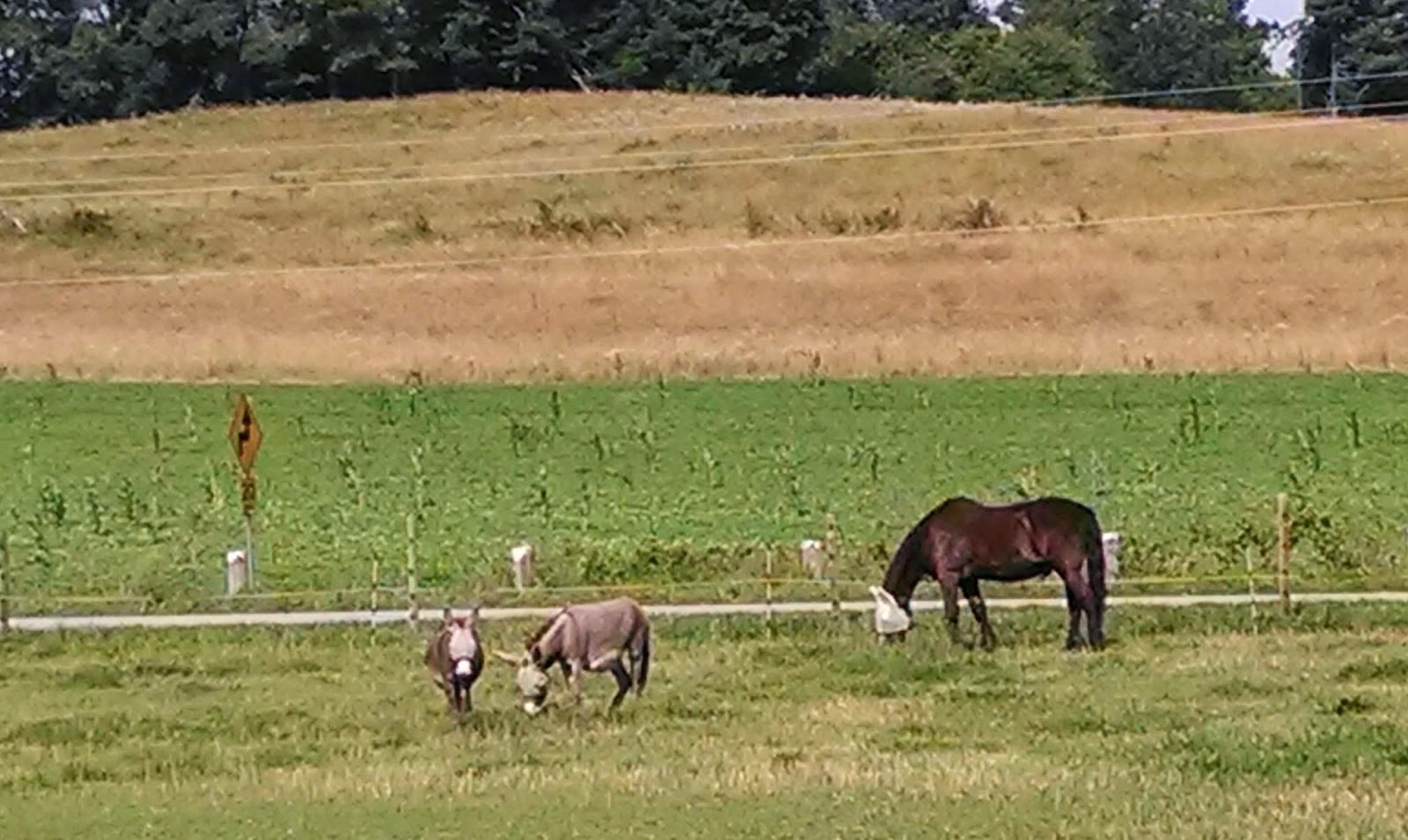
A couple was driving by in their car today and they stopped to look at the horses and donkeys. I could overhear them from across the field. The woman was talking about the masks the animals were wearing. She was concerned that they couldn't see at all and wondered why the owners would blind their animals that way. She asked the driver if the masks were to stop them from running away or something. I wish I could have talked to them. I would have explained that those are fly masks. They keep the flies and gnats out of the animals eyes and ears. Without them, the donkeys and horses ears would be full of scabs from hundreds of bites and there would be flies gathered all around their eyes. Our animals actually like wearing their masks and they can see just fine through them; I've tested it myself. We do take them off at night and when it is raining heavily.
This is the first garlic that we have harvested from the market garden. It looks great! Hope the rest of the crop is as big and healthy looking. We have always grown beautiful garlic on this little farm. Maintaining healthy soil and following long crop rotations are key. We will finish harvesting over the next week and then it will cure for about six weeks in one of our open sheds.

We also pulled off a nice early honey crop. We will not have as much honey for sale as we usually do because we are still recovering from all the hives we have lost over the past two years. This colony collapse disorder is frightening. One day the hive looks healthy and active and the next day the bees are just gone.

We also harvested our first eggplants; fried them up in olive oil with garlic, salt and pepper for dinner tonight. Also had fresh snap peas. Yum. We aren't growing eggplant or snap peas for sale this year, but other farmers at the Mills River Farmers Market are, so check them out tomorrow. We aren't selling on the market yet; it will be late summer before we are there with garlic, honey, and popcorn. In the meantime, I will visit the market to buy berries, lettuce, and other crops we aren't growing. Hope to see you there.


Wednesday, June 25, 2014

My New Book on Ginseng and Goldenseal is Hot Off the Press!

Growing and Marketing Ginseng Goldenseal and Other Woodland Medicinals book
I got so excited when two copies of my new book arrived this morning that I took my first "'selfie" (ever) and just had to share. This has been a long time coming and represents hundreds of hours interviewing, writing, revising, and editing. Writing a book is a labor of love and its almost like holding a new baby when you finally get to pick it up, smell it, and flip through the pages. It is not yet available in stores, so you can still preorder it through the publisher, your local bookstore, or the "big guys" (Amazon and Walmart).

Here's a little about it:


The sudden popularity in wild-harvesting ginseng has increased interest in how to find, grow, and profit from native woodland botanicals. Whereas widespread harvesting of these native plants from our forests can threaten their very existence, the authors of this book promote conservation through cultivation. While there is a great deal of material available -- both in print and on the internet -- that discusses growing ginseng and other woodland botanicals, almost none of it forthrightly assesses profitability and the challenges that may be encountered trying to produce and sell these plants. Forest landowners, if they follow this book and use patience and common sense, can grow many of these native medicinals profitably while preserving and even enhancing their woodlands.

Aspiring herb growers are often attracted first to American ginseng, because it is the most valuable medicinal botanical and because it has a broad, well-established market, which has persisted for over 275 years. Indeed, in the southern part of its range, ginseng has long been referred to as “green gold.” The first half of this book is devoted entirely to this one native plant. An individual can cultivate a forest garden of this fascinating and subtle herb just for his (or her) own consumption, but ginseng also has great potential as a small-scale cash crop with a ready market. With little capital investment, the small farmer can net a greater profit growing ginseng on a rugged, otherwise idle, woodlot than he can net raising just about any other legal crop on an equal area of cleared land. Of course, you have to be willing to take a risk, bend your back, get your hands dirty and  persevere when the payoff is years in the future.

The second half of this book provides practical guidance in the production and marketing of other native woodland herbs that also have the potential to yield “green gold.” Goldenseal and ramps are covered at length and in detail, because their economic potential is well established and reliable information on their propagation is available.  Black cohosh, bloodroot, and ten other lesser known native botanicals are discussed as thoroughly as present knowledge allows, with emphasis on their potential and their uncertainties. Plant botany and usage and present market conditions are addressed in detail. Personal stories of successful growers, extensive references and resources, including a unique Disease List, enhance this book. 

And new to this edition is a section just for home gardeners, information on wild-harvesting, and rules and regulations pertaining to the buying and selling of these plants. It is hoped that this book will help the herb grower to diversify and enjoy a greater variety of woodland medicinal herbs and/or to reduce risk and increase long-term profit potential.


Jeanine Davis is an associate professor and extension specialist with NC State University. Her focus is helping farmers diversify into medicinal herbs, new crops and organic agriculture.

W. Scott Persons is the author of American Ginseng: Green Gold and an expert in growing and marketing wild-simulated and woods-cultivated ginseng.


Thursday, April 10, 2014

Springtime on Our Tiny Farm, plus "the Book" and "See me at the Fair!"


2013 was a trying year on Our Tiny Farm. The rain wouldn't stop, so we had few vegetables for sale; we lost most of our hives, and a family member was dealing with serious health issues. But, 2014 has started out well and we are optimistic that this will be a great year! We are happy to report that with much love and attention, our bee hives are rebounding nicely and we expect to have honey for sale this year. The garlic and shallots look fantastic, so plan to try both this year. We will sell some fresh and some dried. Leeks and potatoes are being planted now. All our beef quarters are sold. Sorry if you missed out on them; the meat is excellent! But our two young Black Angus steers came through the winter looking great. They are enjoying the new spring grass very much.

You can see that our mini-donkeys are all grown up now. We are starting to train them so they can eventually pull a small cart. I have a dream for them to be therapy donkeys, too, but that might have to wait until I have more time. We have a new pony coming to board with us this month; we are excited for that. This spring we will fence in the new pasture area. Haven't decided just what will go in there yet. Could be more cattle, more boarders, a chicken coop, goats...the family needs to make that decision.
My new book, written with coauthor Scott Persons, is scheduled for publication in May! Technically it is a major revision and expansion of our first book, Growing and Marketing Ginseng, Goldenseal, and Other Woodland Medicinals. But with a new publisher, many new chapters--including ones for home gardeners, and a beautiful new layout, photos, and cover--I consider it a new book. You can preorder it now through various on-line booksellers.

I welcome you to hear my presentation on Growing Woodland Botanicals at the Mother Earth News Fair at the WNC Agricultural Center in Asheville (across the street from the airport) this weekend. I will give that presentation on Saturday at 5:30. On Sunday I will speak on hops production at 2:30. And other times you can visit with me at the All About Herbs booths (7010-7015) near the Mother Earth News Stage. Hope to see you there. It will be a beautiful spring weekend.

Sunday, December 22, 2013

Our Tiny Farm Grass-Pasture Raised Beef For Sale Now!

 A delicious smelling beef roast simmering in the crockpot with potatoes, onions, and carrots

We have grass-pastured raised Black Angus beef for sale. These two steers were gently raised on Our Tiny Farm in Etowah, NC. They lived on our pasture eating the fresh grass growing there. In the winter we also fed them locally grown hay, carefully selected to not contain persistent herbicides. The meat was aged for several weeks, butchered, vacuumed packed, and frozen at a USDA inspected facility in Forest City, NC. The beef is boxed in quarters and being held in deep freezers ready for you to purchase at $7.25 per pound plus tax, packaged weight. If you are interested in buying or want to learn more, use the contact form on the right sidebar. We only raise two steers at a time, so the beef sells quickly.


These are the two Black Angus steers in our pasture in November
Upon customer request, we harvested these steers at a smaller size then the ones we raised previously. So each quarter weighs approximately 85-88 pounds. That is finished, packaged weight; just like you would buy meat in a butcher shop or supermarket. (Many farmers sell their beef as "hanging weight" which includes the bone and excess fat. The way we sell it, you know exactly how much meat you are getting). An average quarter contains approximately 3 sirloin steaks, 2 ribeye steaks, 2 round steaks, 7 t-bone steaks, 2 cube steaks, 1 arm roast, 2 sirloin tip roasts, 3 chuck roasts, 11 one-pound packages of stew beef, 3 packages of ribs, and 34 one-pound packages of ground beef (this will, of course, vary some from quarter to quarter).
Our daughter reaching out to pet one of the steers
One of our customers just told us how much her family enjoyed the first roast they cooked. If 87 pounds of beef sounds like a lot, you can always split it with another family, but it also holds in a freezer for a very long time. We held a few steaks and roasts from the steers we harvested in fall 2011 to see how long they retain their quality. We keep them in a standard chest freezer. We recently had several of the 2011 t-bone steaks and they were just as tasty and fresh tasting as they were in the beginning. The vacuum packaging is what does it. We also like the vacuum packaging because you can quickly thaw ground beef, stew beef, ribs, and steaks by putting them in a sink full of water for 20 to 30 minutes. It is not recommended to thaw pasture raised or grass-fed beef in the microwave.
Why don't we call our beef "grass-fed"?  The term "grass-fed" is actually a federal designation for beef that has ONLY been fed fresh grass and hay. Fresh grass and locally grown hay make up more than 99% of our steers' diet, but we do give them a cupful of sweet feed (grain and molasses) frequently to keep them "trained to a bucket". That means they will come running to us whenever they see us with the buckets or hear us shake the buckets with feed in them. We do that so that if they ever get out of their pasture, we can entice them to come home. It also allows us to give them some minerals once in a while, and if they were ever to get sick, we could give them medicine. These two steers were never ill, so they never did receive any antibiotics. But, because we give them that tiny bit of sweet feed, we cannot legally call our cattle "grass-fed". And of course, our cattle never received any hormones. We have not fertilized or sprayed herbicide on the pasture. We use fly predators as the basis for our fly control program. We are NC licensed meat handlers and are certified Appalachian Grown by ASAP.

Monday, November 4, 2013

Pastured Raised Black Angus Beef Aging Now-You Can Place Your Orders

The two Black Angus cattle we raised on our pastures are ready for market. Our daughter thanked them for sharing their lives with us and providing us sustenance.

The meat is aging now. You can pre-order, by the quarter, at this time. We don't have final weights or prices yet. Our meat is priced and sold by the final packaged weight. Most farmers sell by "hanging weight" which includes fat and bones that won't be included in your box. So keep that in mind when you order.


Yesterday, two new Black Angus steers joined us on Our Tiny Farm. They were just weaned. They settled in quickly and seem to like their new home.


This pretty, 11 year old Paint joined us on the farm on Wednesday. So it has been a busy week with animals on Our Tiny Farm!

Friday, October 18, 2013

New Ginseng & Goldenseal Book is Available for Preorder!


I am pleased to announce the newly revised and updated version of our book on ginseng, goldenseal, and other woodland medicinals is now available for pre-order through the publisher and some on-line book retailers. For goldenseal, ramps, and other woodland medicinals, I added a home gardener section with some simple recipes for products to make from the herbs you grow, chapters about wild-harvesting and new regulations affecting the industry, new and updated grower stories, an expanded price list with historical information, and new photographs. Scott revised his ginseng sections and added a chapter on ginseng growing for the home gardener section. This book now provides something for everyone interested in these native woodland plants.

You can preorder the book now directly through the publisher New Society. You can also look for it through your favorite on-line retailer. It was just announced, so that might take a few weeks, although WalMart posted it this week.